
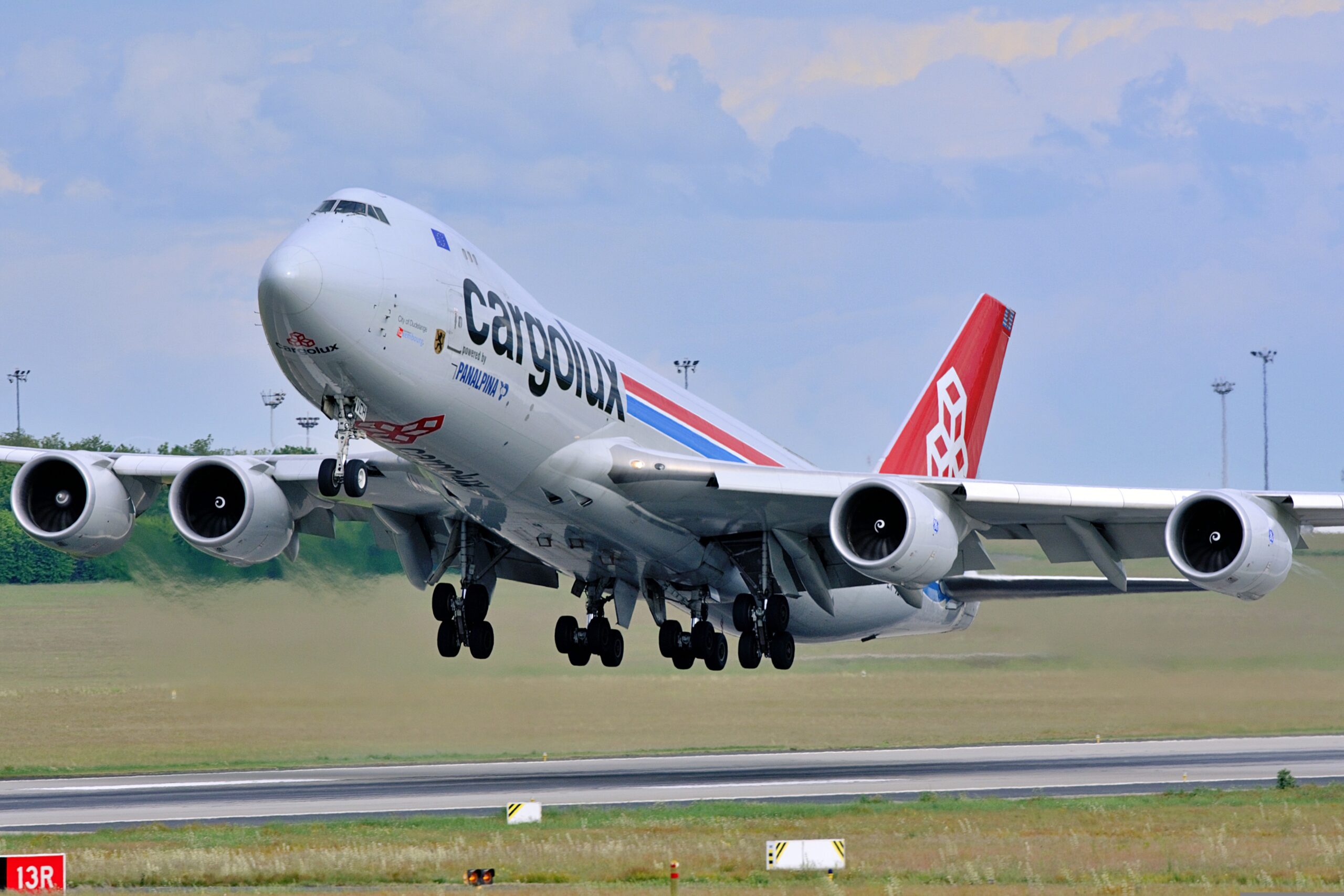
There is a reason the Boeing 747 became synonymous with air cargo. For more than fifty years, no other aircraft has shaped the movement of high-value goods around the world quite like the jumbo freighter.
I had the privilege of leading Cargolux when the airline became the launch customer for the 747-8F, the latest and likely final variant of this remarkable aircraft. That decision was not taken lightly. It was the product of years of analysis, negotiation, and a fundamental bet on what the future of long-haul freight would look like.
Why the 747 works for cargo
The answer starts at the nose. The 747 was designed with a hinged nose door that swings upward, allowing straight-in loading of outsize cargo. This matters enormously. When you need to ship an industrial turbine, a helicopter fuselage, or a production mould that cannot be broken down, the nose door is the only practical solution. No other widebody freighter offers this capability in the same way.
Then there is volume. The 747 has a main deck and lower deck configuration that provides exceptional cubic capacity. Cargo is not just about weight. Many commodities are dimensionally limited before they hit the aircraft’s maximum payload. The 747’s volume allows you to fill the aircraft with lighter, high-value goods without running out of space.
Range matters too. A fully loaded 747-8F can fly over 8,000 kilometres, connecting Asia to Europe or North America in a single hop. This reduces handling, shortens transit times, and simplifies the logistics chain.
The evolution of the fleet
I witnessed the full arc of 747 freighter development. In the early days, most 747 freighters were converted from passenger aircraft. These conversions offered a lower capital cost but came with compromises. The nose door was not available, loading was slower, and the aircraft were often older and less fuel-efficient.
The 747-400F changed that. Built from scratch as a freighter, it offered the nose door, improved range, and better economics. For Cargolux and other pure cargo carriers, the 400F became the workhorse of the fleet through the 2000s.
The 747-8F pushed the concept further. It carries about 16 percent more revenue cargo than the 400F, burns less fuel per tonne-kilometre, and runs quieter. That last point matters more than people realise. Night flying restrictions at European airports make noise performance a genuine operational constraint. An aircraft that can operate under curfews that ground its competitors is worth paying for.
Conversion versus factory-built
The passenger-to-freighter conversion market has grown substantially over the past decade. Widebody passenger aircraft retired earlier than expected during the pandemic became conversion candidates. The economics are attractive: a 15-year-old 777-300ER can be converted to a freighter for a fraction of the cost of a new-build.
But conversions have limitations. They lack the nose door. They often have higher maintenance costs as they age. And their residual values are harder to predict.
For airlines committed to the long haul, factory-built freighters remain the better choice. The higher upfront investment pays back over two decades of operations. This is why Cargolux’s decision to order the 747-8F was about more than the next five years. It was about positioning the airline for the next twenty.
What happens next
Boeing has ended 747 production. The last aircraft rolled off the line in 2022. This does not mean the 747 will disappear from the skies anytime soon. Well-maintained freighters can operate for 30 years or more. But it does mean the industry must now think carefully about what comes next.
The leading candidate is the 777-8F, Boeing’s successor programme. It promises excellent range, fuel efficiency, and lower operating costs. But it lacks the nose door. For operators who depend on outsize cargo, this is a real constraint.
I believe the industry will adapt, as it always does. Some traffic will shift to belly capacity on passenger widebodies. Some will move to smaller, more efficient freighters. And for the truly outsize shipments, the remaining 747s will command a premium for years to come.
The 747 freighter era shaped how global supply chains work. Whatever comes next will have large shoes to fill.
Leave a Reply
You must be logged in to post a comment.